What is a managed fund

A managed fund lets you hand investment decisions to a fund manager.

How a managed fund works



In a managed fund, money from many investors is pooled and invested to match the fund’s investment strategy. The strategies can range from lower-risk cash funds to higher-risk share and property funds. A managed fund can be a simple way to buy a mix of investments in one product.

A fund manager makes investment decisions. The company that legally operates the fund is called the responsible entity or fund operator.

When you invest in a managed fund, you don’t own the underlying investments directly. Instead, you own a stake in the fund. The value of the fund can go up or down. Some funds also pay you income, called distributions.

Some managed funds are bought and sold on an exchange like the ASX. These can include exchange-traded funds, or ETFs.

If you have super, it is likely you already invest in managed funds.

Smart Tip: Managed funds go by different names. You may see terms like unit trust, mutual fund, managed investment scheme, or Corporate Collective Investment Vehicle (CCIV).

Types of managed funds

What managed funds invest in

Single asset managed funds

These funds invest in one asset class. An asset class is a group of similar investments.

Cash funds – invest in very low-risk, short-term investments like bank deposits and short-term government bonds. They are low risk, but returns are usually lower too.

Fixed interest or bond funds – invest in loans to governments and companies. They can hold higher-risk loans that pay more interest.

Private credit funds – invest in loans that are not publicly traded. Risk and return depend on the borrowers and how the loans are structured. These can be higher risk.

Mortgage funds – invest in property loans. They can pay income so long as their borrowers keep paying. They can fall in value if borrowers default.

Property funds – invest in property or property-related assets. Some are higher risk.

Share (equity) funds – invest in shares in Australian or overseas companies. They can offer higher returns. Their value can also swing more sharply.

Alternative investment funds – include hedge funds, private equity, derivatives and commodities. These can be higher risk and more complex.

Mixed asset or multi-sector managed funds

These funds invest across more than one asset class. They are usually labelled by how much of the fund is held in growth assets like shares and property, and defensive assets like cash and bonds.

Growth – around 85% growth assets, the rest defensive.

Balanced – around 70% growth assets, the rest defensive.

Conservative – around 30% growth assets, the rest defensive.

Cash – 100% cash or cash-equivalents such as short-term deposits and bank bills.

How managed fund investments are chosen

Active funds rely on a fund manager to make ongoing decisions about investments. Some aim to beat a market index. Others aim to produce steady income or protect against loss. Some active funds use an absolute return strategy that aims for positive returns regardless of what markets are doing.

Passive funds – also called index funds – try to match a market index rather than beat it. There is less day-to-day decision-making, so fees are usually lower than active management fees.

Responsible, sustainable or ethical funds screen investments against environmental, social or governance criteria. These can be active or passive.

Benefits of managed funds

Managed funds can make investing easier for people who do not want to choose every investment themselves.

Benefits include:

  • access to a range of investments in one product

  • professional management

  • easier diversification, which means spreading your money across different investments

Risks of managed funds

Managed funds are not risk-free. The value of your investment can fall, and you may get back less than you invested.

Risks can include:

  • market risk – the assets in the fund can fall in value because of events affecting the entire market

  • sector risk – a fund focused on one part of the economy can be hit harder when that sector does badly

  • liquidity risk – you may not be able to get your money out as quickly as expected, and funds can restrict, delay or stop withdrawals in some circumstances

  • currency risk – overseas investments can be affected by changes in exchange rates

  • inflation risk – your returns may not keep up with rising prices, so your money buys less over time

  • interest rate risk – changes in interest rates can affect the value of the fund’s investments, especially bonds and other loans

  • credit risk – a borrower that the fund has lent to may not repay the loan

  • concentration risk – holding a small number of investments means any single loss has a bigger impact on the fund

  • gearing risk – if the fund borrows to invest, both gains and losses are magnified

Not every managed fund will have all these risks. The main risks depend on what the fund invests in and how it is managed.

Mia buys a diversified managed fund

Mia has saved $8,000 and wants to start investing in shares. She does not feel confident choosing individual shares, so she looks at managed funds that invest in Australian shares and overseas shares. She reads the Product Disclosure Statement to check how the fund invests, the fees she will pay, and the level of risk. Mia sees that using a managed fund could help her access a diversified mix of investments to lower her risk. She buys units directly with the manager.

Deciding if managed funds are right for you

There are a lot of different ways you can invest your money – managed funds are just one option.

Managed funds might suit you if:

  • you want a simple way to invest

  • you want your money spread across a range of investments

  • you do not want to choose and manage each investment yourself

  • you are comfortable that the value can rise and fall

Managed funds may not suit you if:

  • you want full control over every investment choice

  • you need your money back at short notice

  • you do not want to pay ongoing fees

  • you are not comfortable with the risk of losses

Managed funds are not an appropriate investment for everyone. It’s important to consider your investing timeframe and risk tolerance.

Contact us if you have any questions.

Source: Moneysmart
Reproduced with the permission of ASIC’s MoneySmart Team. This article was originally published at
https://moneysmart.gov.au/managed-funds-and-etfs/what-is-a-managed-fund
Important note: This provides general information and hasn’t taken your circumstances into account. It’s important to consider your particular circumstances before deciding what’s right for you. Although the information is from sources considered reliable, we do not guarantee that it is accurate or complete. You should not rely upon it and should seek qualified advice before making any investment decision. Except where liability under any statute cannot be excluded, we do not accept any liability (whether under contract, tort or otherwise) for any resulting loss or damage of the reader or any other person. Past performance is not a reliable guide to future returns.
Important
Any information provided by the author detailed above is separate and external to our business and our Licensee. Neither our business nor our Licensee takes any responsibility for any action or any service provided by the author. Any links have been provided with permission for information purposes only and will take you to external websites, which are not connected to our company in any way. Note: Our company does not endorse and is not responsible for the accuracy of the contents/information contained within the linked site(s) accessible from this page.


Learn how defined benefit super works and what it could mean for retirement. 

What is defined benefit super?

Defined benefit super is a type of super account that works differently from most other super accounts.

Most defined benefit super accounts were set up by an employer. The employer’s rules help determine what you’ll get when you retire.

Defined benefit super accounts are less common and only accept certain workers or no longer take new members.

Most super accounts have a balance that rises and falls over time, based on how much money you and your employer put in and how you invest it. This affects what you’ll get when you retire.

With a defined benefit account, your super fund uses a formula to work out what you’ll get instead.

 If you’re thinking about leaving a defined benefit fund, talk to your super fund, or speak to us first. Some funds offer benefits that you may lose if you leave, and you generally can’t rejoin.

How a defined benefit account works

The formula your fund uses to work out what you’ll get when you retire may differ from what other defined benefit funds use.

It may consider:

  • the money your employer puts in, and any contributions you make (if your fund allows them)

  • your average salary before retirement

  • how long you worked for your employer

  • your age when you retire.

For example, a retirement benefit calculation might look like this.

A fund uses the following formula to work out your benefit (i.e. how much you’ll get) at retirement:

Average salary for the last 3 years × total years of service with the employer who sponsors the defined benefit account × benefit factor.

If a member:

  • had an average salary of $100,000

  • worked for 20 years at the employer, and

  • has a benefit factor of 0.15

their estimated retirement benefit would be:

$100,000 × 20 × 0.15 = $300,000

Example only
This example is simplified to show how a defined benefit account may work. Every defined benefit fund uses its own formula. Your fund may use different factors when calculating your benefit.

Are defined benefit funds still available?

Most defined benefit funds no longer accept new members. Many were offered by government employers, public sector organisations, universities and large employers.

If you’re already a member, you can usually stay in the fund while you’re eligible.

What happens when you retire?

When you retire, your defined benefit fund may offer:

  • a regular income stream

  • a lump sum, or

  • a combination of both.

Your options depend on your fund. 

What is a defined benefit income stream?

A defined benefit income stream pays you a regular income from a defined benefit super scheme.

Your fund works out how much you receive.

Unlike an account-based pension, payments do not usually depend on an account balance or investment returns.

Payments, tax and death benefits can vary between funds.

Understand how different retirement income options can work together to fund your retirement including account-based pensions and lifetime income streams. 

Before making changes to your defined benefit super

Defined benefit accounts can offer benefits that other super accounts don’t.

Making changes may affect:

  • your future retirement income

  • your access to pension benefits

  • the tax you’ll pay

  • benefits for your partner or dependants.

Before you decide, contact your fund and consider speaking to us for financial advice.

High-pressure sales tactics are putting your super savings at risk. Be on red alert for phone calls, click bait advertising and promises of unrealistic returns to encourage you to put your super into risky investments. Stop, think carefully, and check the claims first.

Questions to ask your fund

Every defined benefit fund works differently. Your fund can explain how your account works.

You may want to ask:

  • how your benefit is calculated

  • what options you have at retirement

  • whether you can receive a pension, lump sum or both

  • how your benefit may be taxed

  • what happens if you leave the fund or transfer your benefits.

Source: Moneysmart
Reproduced with the permission of ASIC’s MoneySmart Team. This article was originally published at https://moneysmart.gov.au/how-super-works/defined-benefit-super-explained
Important note: This provides general information and hasn’t taken your circumstances into account.  It’s important to consider your particular circumstances before deciding what’s right for you. Although the information is from sources considered reliable, we do not guarantee that it is accurate or complete. You should not rely upon it and should seek qualified advice before making any investment decision. Except where liability under any statute cannot be excluded, we do not accept any liability (whether under contract, tort or otherwise) for any resulting loss or damage of the reader or any other person.  Past performance is not a reliable guide to future returns.
Important
Any information provided by the author detailed above is separate and external to our business and our Licensee. Neither our business nor our Licensee takes any responsibility for any action or any service provided by the author. Any links have been provided with permission for information purposes only and will take you to external websites, which are not connected to our company in any way. Note: Our company does not endorse and is not responsible for the accuracy of the contents/information contained within the linked site(s) accessible from this page.

In Australia, there are both ownership and rental opportunities to choose from when deciding on the best retirement living option for you.

Key points:

  • There are varying tenure types that can impact your rights over a property in a village

  • Make sure to understand all the costs and fees that are associated with taking a placement in a retirement village

  • Legislation and regulations differ depending on the State or Territory you live in

Generally, the deciding factor of whether you rent or buy is subject to your current financial situation.

However, you should also consider the retirement lifestyle you want to lead and whether ownership or renting will best assist in reaching those wishes and desires.

Retirement villages can be a really attractive option after you retire, encompassing a safe environment with a close-knit community of older people with similar interests and hobbies, and active social groups.

In most cases, moving into a retirement village is a great way to start downsizing your possessions and assets.

Ownership and legalities

There are different pros and cons when it comes to owning or renting a home in a retirement village.

For instance, if you rent a home, it can be less expensive depending on how long you live there. Whereas, if you buy, you don’t have to worry about any rental issues and have greater control over your home.

Either way, a retirement home will cut into your superannuation, along with additional costs and fees associated with living in a village.

Property ownership in retirement villages comes under slightly different legislation to normal homeownership.

They have different forms of legal title and occupancy rights, and other costs such as stamp duty may or may not apply.

Types of tenure

The various forms of occupation or ownership rights of retirement villages are referred to as ‘tenure’. They will include provisions for resident consultation about the management of the community and the use of the village facilities.

The legal forms of tenure for buying into retirement villages are:

Leasehold estates: The owner/developer continues to own the property, however, you pay the market value of the unit in exchange for a period of time (49 – 199 year lease). This is generally the most common form of tenure used by ‘for profit’ developers.

Licences to occupy: The village developer or owner gives you a licence to occupy your unit which means you are permitted to stay under certain conditions such as not altering the property or surrounding gardens. This form of tenure is generally the most common used by ‘not-for-profit’ developers.

Company share arrangement: The village is still owned by the retirement village developer. They will sell you shares which entitles you to live in your unit. Although some retirement villages use this tenure, it’s not a common form of tenure.

Strata title ownership: Similar to regular strata-title schemes where the property is divided into units, this operates as a direct ownership structure. You pay the agreed purchase price, are registered on the title deed and become a member of the owners’ corporation. However, unlike regular strata, the retirement village operator may have to approve you as a resident and you sign a management contract with the village owner.

This is not a common form of tenure for retirement villages.

Community title ownership: This is a very rare form of tenure for retirement villages and operates on a direct ownership structure similar to strata, except in community title, the land is divided into ‘Lots’.

Ongoing costs

Even though you have paid the market value for your property under the different tenures, you will still have ongoing costs and fees to pay in addition to your regular utility bills and in some villages, council tax.

These additional costs are sometimes known as service or maintenance fees and cover costs for the village management and maintenance.

Be across all the costs and fees that are involved with living in a village before you move in so you are not surprised by any unexpected fees.

Always read the resident’s handbook and take legal and financial advice so you fully understand what you are buying into and what your responsibilities are.

Rental units

Some residential villages do offer accommodation rental units, sometimes known as periodic tenancy, but these are generally reserved for people with limited financial resources and are usually income assessed.

Because of this, rental units are often in high demand and you may have difficulty finding one.

Where do I find a rental unit?

Rental units come in all shapes and sizes, and can be found in both small and large villages or retirement living complexes.

The main providers of rental accommodation for seniors are non-profit organisations such as religious, charitable and other benevolent organisations and local councils. However, the private sector is beginning to develop more purpose–built rental accommodation for seniors.

How much is the rent?

You will generally be charged a rental that is a percentage of the age pension plus maximum rent assistance available from Centrelink (regardless of whether you are receiving the age pension or rent assistance).

What services do rental developments offer?

Rental developments may offer the following services:

  • Self-contained units with quality fittings

  • The provision of all meals

  • Laundry services

  • Communal facilities

  • Social activities

  • Secure environment

  • Independent lifestyle

Government legislation

There is legislation to protect the rights of retirement village residents, but this is regulated by the individual States and Territories.

The legislation for each State and Territory Retirement Acts can be found by clicking on the following links:

ACT: Retirement Villages Act 2012 and Regulations

NSW: Retirement Villages Act 1999 and Regulations

NT: Retirement Villages Act 1995 and Regulations

QLD: Retirement Villages Act 1999 and Regulations

SA: Retirement Villages Act 2016 and Regulations

TAS: Retirement Villages Act 2004 and Regulations

VIC: Retirement Villages Act 1986 and Regulations

WA: Retirement Villages Act 1992 and Regulations

Some states and territories also have Resident Associations who can help with advocacy, legal aspects and also promote the rights of residents to all levels of government.

Source: Aged Care Guide
Reproduced with permission of Care & Co Media. This article was originally published on https://www.agedcareguide.com.au/information/renting-or-owning
Important: This provides general information and hasn’t taken your circumstances into account. It’s important to consider your particular circumstances before deciding what’s right for you. Although the information is from sources considered reliable, we do not guarantee that it is accurate or complete. You should not rely upon it and should seek qualified advice before making any investment decision. Except where liability under any statute cannot be excluded, we do not accept any liability (whether under contract, tort or otherwise) for any resulting loss or damage of the reader or any other person. 
Any information provided by the author detailed above is separate and external to our business. Our business does not take any responsibility for any action or any service provided by the author. Any links have been provided with permission for information purposes only and will take you to external websites, which are not connected to our company in any way. Note: Our company does not endorse and is not responsible for the accuracy of the contents/information contained within the linked site(s) accessible from this page.
Floating rate bonds tend to receive less attention than shares or fixed rate bonds.

Yet in Australia, floating rate bonds are far from niche. They play a starring role in Australia’s credit market as the favoured source of debt funding by the major banks.

Floating rates are a familiar concept in our financial lives too, with most Australian mortgages structured on variable rather than fixed interest rates.

Floating rate bonds can also deliver important benefits in a diversified portfolio. By adjusting their interest payments as market rates change, they offer the potential for regular income, lower price sensitivity to interest rate movements and an additional source of diversification alongside other investments.

What are floating-rate bonds?

Like regular fixed income bonds, floating rate bonds are loans made to governments or companies that pay investors interest.

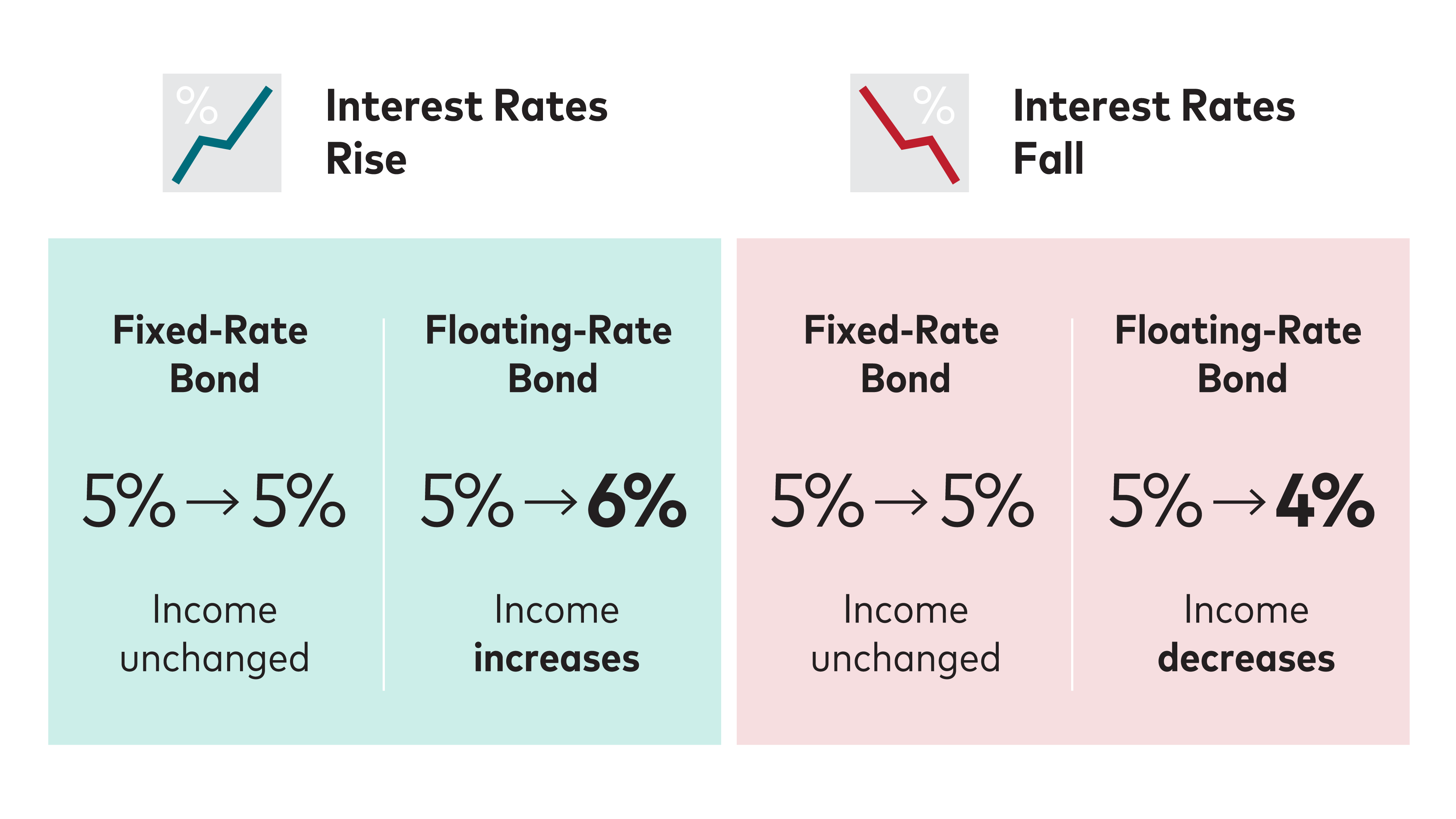
The key difference is that the interest payments on floating rate bonds can change over time. Rather than being fixed for the life of the bond, they typically move in line with short-term interest rates.

This means investors may benefit from higher income payments when interest rates rise, while still maintaining exposure to the defensive characteristics that bonds can provide.

Floating-rate bonds provide income that adjusts as interest rates change

Why investors use floating-rate bonds

Every investment plays a different role in a portfolio.

Shares can help drive long-term growth. Fixed income can help generate income and diversify risk. Cash can provide liquidity and stability. Listed property can also provide exposure to real assets and potential income, while behaving differently to shares, bonds and cash.

Floating rate bonds sit within the fixed income part of a portfolio but offer a different set of characteristics to fixed rate bonds.

1. Regular income

Many investors turn to bonds for income.

Because the interest payments on floating rate bonds adjust over time, the income generated by these securities can move with changes in market interest rates. This can make them an attractive option for investors seeking income from the defensive side of their portfolio.

2. Reduced sensitivity to interest rates

The value of fixed-rate bonds can be affected by changes in interest rates.

Floating-rate bonds are generally less sensitive to these movements because their interest payments reset periodically. As a result, their prices may experience smaller fluctuations when interest rates change.

3. Diversification

A well-diversified portfolio typically contains a mix of assets that can behave differently under different market conditions.

Floating-rate bonds can complement shares, cash and traditional bonds by providing an additional source of income and diversification.

Accessing floating rate bonds through a single investment

For many investors, building a diversified portfolio of individual bonds can be complex.

Exchange-traded funds (ETFs) provide a convenient way to access a broad range of securities through a single investment.

Where could floating-rate bonds fit in a portfolio?

There is no one-size-fits-all approach to investing, and every investor’s circumstances are different.

However, floating rate bonds may be worth considering for investors who are looking to:

  • Generate income from the defensive portion of their portfolio.

  • Diversify beyond shares and cash.

  • Reduce price sensitivity to changing interest rates.

  • Build a more balanced portfolio through exposure to different types of fixed income investments.

Importantly, floating-rate bonds are not intended to replace every other defensive investment. Instead, they can be used alongside cash, fixed rate bonds and other fixed income investments as part of a diversified portfolio.

A useful addition to the fixed income toolkit

Floating rate bonds have become an increasingly important part of many investment portfolios because they offer a unique combination of income potential, diversification and lower sensitivity to interest rate movements.

For investors looking to strengthen the defensive side of their portfolio, they may be worth a closer look.

Source: Vanguard
Reproduced with permission of Vanguard Investments Australia Ltd Vanguard Investments Australia Ltd (ABN 72 072 881 086 / AFS Licence 227263) is the product issuer. We have not taken yours and your clients’ circumstances into account when preparing this material so it may not be applicable to the particular situation you are considering. You should consider your circumstances and our Product Disclosure Statement (PDS) or Prospectus before making any investment decision. You can access our PDS or Prospectus online or by calling us. This material was prepared in good faith and we accept no liability for any errors or omissions. Past performance is not an indication of future performance. © 2026 Vanguard Investments Australia Ltd. All rights reserved. Important: Any information provided by the author detailed above is separate and external to our business and our Licensee. Neither our business nor our Licensee takes any responsibility for any action or any service provided by the author. Any links have been provided with permission for information purposes only and will take you to external websites, which are not connected to our company in any way. Note: Our company does not endorse and is not responsible for the accuracy of the contents/information contained within the linked site(s) accessible from this page.

Retirement starts long before your last day at work

There are certain moments in life that reshape not just your finances, but the way you live.

Starting a family, moving overseas for a job, changing careers – retirement belongs in that same category in terms of its significance.

Traditionally, retirement has been viewed as a single milestone celebrated on the day you stop working. But in reality, it’s one of the longest and most significant chapters of your life – one that’s being reshaped by longer life spans, evolving retirement rules and rising living costs. 

With Australians now living longer than ever, retirement can span decades, bringing new priorities, changing spending habits and different financial decisions along the way.1

That means retirement isn’t simply something to prepare for. It’s something you’ll need to navigate through.

Know what you’re aiming for

Before thinking about how you’ll fund retirement, however, it’s worth asking a simpler question: What kind of retirement do you actually want?

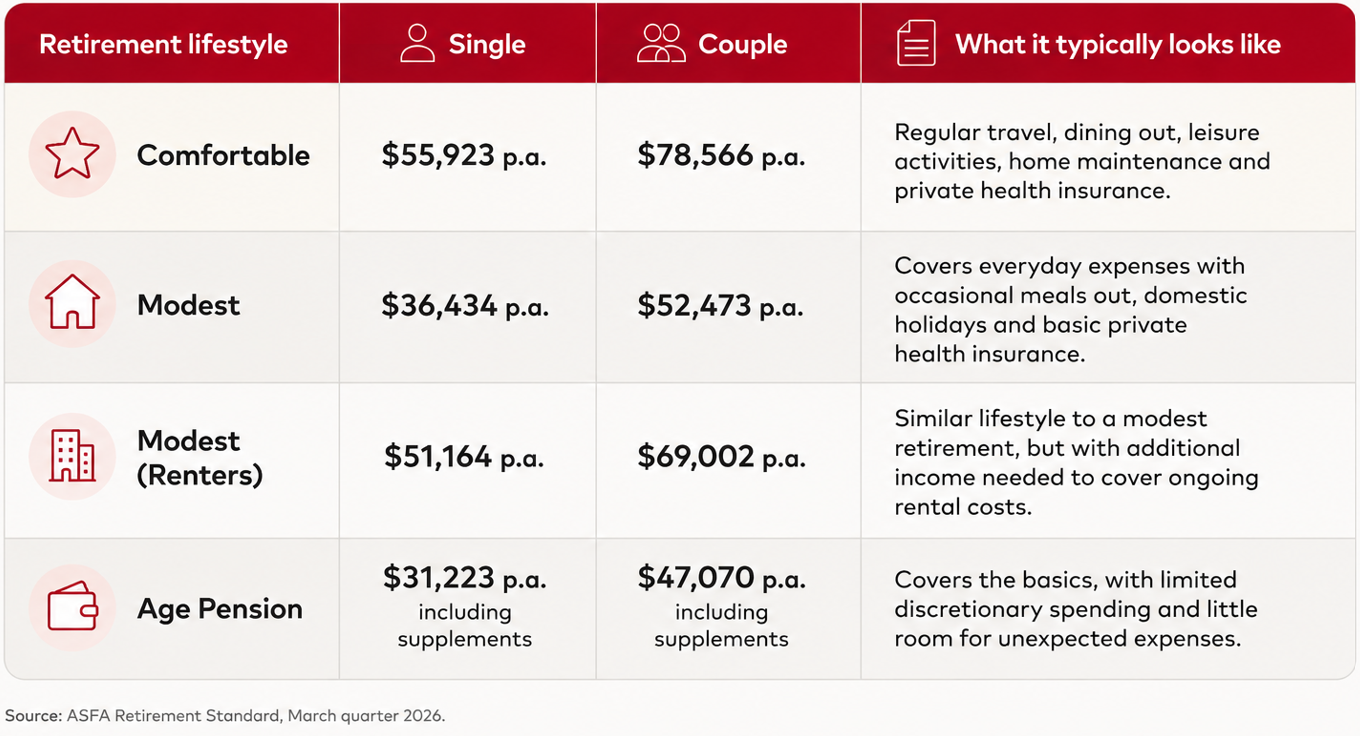
The Association of Superannuation Funds of Australia (ASFA) Retirement Standard provides a useful benchmark by estimating the annual income needed to support different retirement lifestyles.

There’s no right or wrong answer. Some Australians dream of travelling the world, while others are happiest spending more time with family, pursuing hobbies or enjoying a slower pace of life closer to home.

The important thing is having a destination in mind. After all, it’s difficult to know whether you’re saving enough – or investing appropriately – if you don’t know what you’re trying to fund.

With that in mind, here are the three broad phases of retirement and the financial considerations that tend to become most important in each.

Phase 1: Building your retirement runway

The five to ten years before retirement are a critical time for financial planning.

This is when many of the biggest financial decisions get made – when to retire, what sort of lifestyle you want, whether you’re saving enough and how to make the most of your remaining working years.

Having a clear retirement plan can make a meaningful difference. A recent report has shown Australians who understand the steps they need to take for retirement are significantly more confident about funding their desired lifestyle and more optimistic about their future than those without a plan.

It’s also the time to take stock of your financial position.

While seven-figure super balances often grab headlines, they’re far from the norm. Australians aged 60 to 64 have a median super balance of around $236,126 for men and $174,655 for women.2 

With many Australians approaching retirement with relatively modest super balances, making the most of available opportunities to contribute to super and strengthen retirement savings can be particularly valuable.

Here are several key questions to ask in the decade leading up to retirement: 

  • How much do I currently have in super and other investments, and will it support the lifestyle I want in retirement?

  • Are there any big-ticket experiences I want to budget for, such as a luxury cruise, overseas travel or helping my children financially?

  • Will I be in a position to pay off my mortgage before retirement?

  • Do I want to stop working completely, or gradually transition through part-time or consulting work?

  • Would downsizing or relocating improve my retirement lifestyle or financial position?

Phase 2: Putting your nest egg to work

Once retirement begins, your financial mindset will likely shift.

Instead of building wealth, the priority becomes generating an income that can support your lifestyle while ensuring your savings last for what could be another 20 or 30 years.

For many people, this can be an uncomfortable transition. After spending decades trying to grow your retirement savings, you’re now relying on them to fund your lifestyle 

Retirees also need to consider sequencing risk – the impact a market downturn can have if it occurs early in retirement while you’re simultaneously drawing an income from your portfolio.

As a result, some retirees choose to maintain exposure to growth assets alongside defensive investments and cash, depending on their circumstances, objectives and tolerance for risk.

While liquidity can help fund day-to-day spending and reduce the need to sell investments during volatile markets, growth remains important because inflation continues long after your working life ends.

Your retirement income may also come from multiple sources including investments held outside super and, depending on your circumstances, the Age Pension.

Here are several key questions to consider as you approach and enter retirement:

  1. Where will my retirement income come from – super, investments, rental income, the Age Pension or a combination of these?

  2. Is my investment portfolio still appropriate now that my focus has shifted from building wealth to drawing an income?

  3. Can my income keep pace with inflation?

  4. Do I have enough cash or liquidity to cover unexpected expenses or periods of market volatility?

  5. Am I reviewing my spending regularly to ensure my savings remain sustainable over the long term?

Phase 3: Planning your legacy

As retirement progresses, financial planning often becomes about much more than investment returns.

Many retirees begin thinking more carefully about how they’ll be cared for if their health changes, whether their current home still suits their needs and how they want their assets distributed to loved ones.

While these conversations aren’t always easy, planning ahead can provide greater flexibility, reduce stress for your family and ensure your wishes are understood well before important decisions need to be made.

At some stage during retirement, these are some of the conversations worth having:

  1. Is my will up to date, and have I reviewed my beneficiary nominations?

  2. Have I considered how I would fund aged care or additional healthcare needs if they arise?

  3. Does my current home still suit my needs, or would another living arrangement be more appropriate?

  4. Have I appointed the right people to make financial or medical decisions if I’m unable to do so?

  5. Does my estate plan reflect the legacy I want to leave for my family and loved ones?

Strategies to consider

Your retirement plan doesn’t need to be perfect. The important thing is to start early, review it regularly and adapt it as your circumstances change. 

Here are some practical strategies to consider. As always, it’s important to consider whether any strategy is appropriate for your personal circumstances and seek professional advice if needed.

  • Start small. Retirement planning doesn’t have to happen all at once. Start by discussing a few key questions with your partner (or you can contact us) such as when you’d like to retire and how much super you may need.

  • Review your super regularly. Make a habit of logging into your super account and checking your balance, investment options, fund performance and insurance cover.

  • Make the most of super contributions. If you’re still working, additional concessional (before-tax) contributions could help grow your retirement savings. 

  • Understand carry-forward contribution caps. If your total super balance is below $500,000 and you meet the eligibility requirements, you may be able to use unused concessional contribution caps from the previous five financial years.

  • Learn about downsizer contributions. If you’re 55 or over and meet the eligibility requirements, selling your home may allow you to contribute up to $300,000 each (or $600,000 per couple) into super.

Contact us if you have any questions.

1. ASFA Retirement Standard Budgets for various households and living standards for those aged 65-84 (March quarter 2026)
2. Median super balance, by age and sex, 2023–24 financial year – Australian Taxation Office

Source: Vanguard
Reproduced with permission of Vanguard Investments Australia Ltd
Vanguard Investments Australia Ltd (ABN 72 072 881 086 / AFS Licence 227263) is the product issuer. We have not taken yours and your clients’ circumstances into account when preparing this material so it may not be applicable to the particular situation you are considering. You should consider your circumstances and our Product Disclosure Statement (PDS) or Prospectus before making any investment decision. You can access our PDS or Prospectus online or by calling us. This material was prepared in good faith and we accept no liability for any errors or omissions. Past performance is not an indication of future performance.
© 2026 Vanguard Investments Australia Ltd. All rights reserved.
Important: Any information provided by the author detailed above is separate and external to our business and our Licensee. Neither our business nor our Licensee takes any responsibility for any action or any service provided by the author. Any links have been provided with permission for information purposes only and will take you to external websites, which are not connected to our company in any way. Note: Our company does not endorse and is not responsible for the accuracy of the contents/information contained within the linked site(s) accessible from this page.
For many people approaching retirement, the transition from full-time work to retirement is no longer a sudden stop. Instead, it’s often a gradual process that involves reducing work hours, maintaining cash flow and continuing to build retirement savings.

One strategy that can support this approach is a Transition to Retirement Income Stream (TRIS or TTR).i

While TTR strategies have been available for many years, they are often overlooked despite offering valuable flexibility for people in their 60s who are still working.ii

What is a TTR strategy?

A TTR strategy allows you to access some of your superannuation while continuing to work, provided you have reached your preservation age. For anyone born on or after 1 July 1964, preservation age is 60.iii

The arrangement works by transferring part of your super balance into a TTR pension account. You then receive regular pension payments while continuing to earn employment income. This can help replace lost income if you reduce your working hours or supplement your cash flow while making additional contributions to super.

Unlike a standard retirement-phase pension, a TTR pension has restrictions. Generally, you must draw a minimum pension each year and cannot withdraw more than 10 per cent of the account balance annually. Lump-sum withdrawals are generally not permitted while the TTR remains in the pre-retirement phase.iv

Who might benefit?

A TTR strategy may suit people who:

  • want to reduce their working hours without a significant drop in income

  • are approaching retirement but are not ready to stop work completely

  • earn a moderate to high income and wish to boost superannuation through salary sacrifice

  • want greater flexibility in planning their transition from work to retirement.

For example, someone aged 60 might decide to move from working five days a week to three days a week. By drawing a pension from their super, they can help replace part of their lost income and ease gradually into retirement.

Combining work income and pension payments

One of the key attractions of a TTR strategy is the ability to combine employment income with pension payments.

If you are aged 60 or over, pension payments received from a TTR income stream are generally tax-free in your hands. Instead of experiencing a substantial reduction in disposable income, a tax-free pension payment can help bridge the gap.

The tax-saving strategy

Another commonly used TTR strategy involves salary sacrifice.v

In this approach, an employee diverts part of their salary into superannuation through concessional contributions, which are generally taxed at 15 per cent within the super fund. The reduction in take-home pay is then partially replaced through tax-free TTR pension payments.

For people on higher marginal tax rates, this may improve tax efficiency because income that would otherwise be taxed at personal rates may instead be contributed to super and taxed at a lower rate. The TTR pension can then be used to maintain cash flow.

In some circumstances, this strategy may also help increase retirement savings while maintaining a similar standard of living before retirement.

Opportunities

  • Smoother transition into retirement
    One of the biggest benefits is flexibility. Rather than stopping work abruptly, a TTR strategy can support a gradual reduction in work hours.

  • Tax-free pension payments after age 60
    For many Australians, TTR pension payments received after age 60 are tax-free, which can improve overall cash flow and make part-time work more financially attractive.

  • Continued super contributions
    Even while receiving a TTR pension, your employer must continue making Super Guarantee contributions if you remain eligible. This helps replenish part of the super being withdrawn.vi

  • Potential tax efficiencies
    For some higher-income earners, combining salary sacrifice with a TTR income stream may reduce overall tax and improve retirement outcomes.

Considerations

A TTR strategy may not be suitable for everyone.

  • Reduced retirement savings
    Drawing on super before fully retiring means your retirement capital may have less time to grow. If withdrawals exceed ongoing contributions and investment growth, your final retirement balance may be lower.

  • Earnings within the pension are not tax-free
    Many Australians are surprised to learn that TTR pensions no longer receive the same tax treatment as retirement-phase pensions.

    Since the 2017 reforms, investment earnings on assets supporting a TTR pension that is not yet in retirement phase are generally taxed at 15 per cent. The fund cannot claim exempt current pension income on those assets until the member satisfies a full condition of release, such as retirement or turning 65.

  • Government benefit implications
    A TTR strategy may affect eligibility for certain government benefits or entitlements.

  • Additional complexity
    Managing pension withdrawals, contribution caps, salary sacrifice arrangements and tax consequences can become complicated. Professional advice is often valuable to ensure the strategy remains effective and compliant.

Is a TTR strategy right for you?

A Transition to Retirement strategy can provide valuable flexibility for people who want to scale back work, supplement their income or potentially improve the tax efficiency of their retirement planning.

But the benefits depend heavily on individual circumstances, including age, income level, super balance, retirement objectives and tax position. What works well for one person may offer little benefit for another.

If you are approaching retirement and would like to explore whether a TTR strategy could help you achieve your goals, please contact our office. We can help assess whether the approach aligns with your broader retirement and financial planning objectives.

i Transition to retirement | ATO
ii Transition to retirement – Moneysmart.gov.au
iii Preservation age | ATO
iv TRIS requirements | ATO
v Using TTR to save on tax | Moneysmart
vi Super guarantee contributions and TRIS | ATO

If the financial markets could talk, then bonds would probably be saying: “We’re not convinced the story is over yet”.

Bond yields have been rising around the world as investors reassess the outlook for inflation, economic growth and government borrowing. The moves have been significant enough to influence mortgage rates, government finances and investment portfolios.

Experienced bond investors will be well aware of what’s been happening. For everyone else, the developments offer the chance to understand why professional investors see the bond market as one of the economy’s most important barometers.

You might never have bought a bond, researched a bond ETF or checked the yield on a government bond. But there’s a good chance that bonds already play a role in your investment portfolio through your superannuation account.

That’s one reason the recent attention on bond markets matters.

Looking back

To understand why bonds are attracting attention now, it helps to take a look back.

From the early 1980s to around 2020, developed economies experienced one of the longest declines in interest rates and bond yields in modern history. Falling inflation, globalisation, technological advances and relatively stable economic conditions helped drive yields steadily lower.

Following the Global Financial Crisis and then the COVID-19 pandemic, many government bond yields fell to historically low levels. In some countries, investors were even willing to accept negative yields.

That changed dramatically from 2022 onwards as inflation surged. Central banks, including the Reserve Bank of Australia, responded by rapidly increasing interest rates.

The rapid increase in yields created short-term pain for existing bond investors but ultimately restored something that had been largely missing from bond markets for years: meaningful income.

Today, many commentators believe the era of ultra-low bond yields may be over. While inflation has eased from its peak, investors are increasingly questioning whether interest rates will return to the unusually low levels that prevailed during the 2010s.i

What’s happening in Australia?

Australian bond yields have moved higher during 2026 as investors responded to stronger than expected inflation and economic activity, and commentators are not confident that inflation will return quickly to the Reserve Bank’s target range.

Three-year government bond yields moved above 5 per cent, while 10-year bond yields approached levels not seen for more than a decade.ii

Higher yields affect far more than investment portfolios. Governments face increased borrowing costs, businesses pay more to raise capital, and lending rates throughout the economy may come under upward pressure.

The global picture

But Australia is not alone. Across the world, governments are issuing large amounts of debt to fund spending commitments, infrastructure projects and budget deficits.

Earlier this year, the International Monetary Fund (IMF) warned about the risks of geopolitical tensions, inflation uncertainty and rising levels of government debt.

Meanwhile, BlackRock notes that government borrowing is increasingly competing with private-sector demand for capital, helping push long-term yields higher in many countries. Its investment team believes that higher yields have created attractive income opportunities, but investors need to be more selective than in the past.

Understanding duration

‘Duration’ is one of the most important concepts in bond investing.

It measures how sensitive a bond’s price is to changes in interest rates. Generally speaking, the longer a bond’s duration, the more its price will move when rates change.

For example, a 10-year bond will usually experience greater price movements than a two-year bond if market interest rates rise or fall.

That helps explain why some bonds can experience significant short-term losses even when the issuer is considered financially secure. Investors often focus on credit risk, but interest-rate risk can be just as important.

The sharp rise in global yields over recent years has highlighted the importance of duration. Longer-dated bonds, which benefited hugely when rates were falling, were among the hardest hit when yields moved higher.

The bottom line

After years of being overlooked, bonds are once again demanding investors’ attention with higher yields providing more income than for much of the last decade.

At the same time, the rising yields are a reminder that bonds are not risk-free and that issues such as duration, inflation and government borrowing matter.

Although forecasts differ on the precise direction of interest rates, there appears to be broad agreement that investors should prepare for a more complex bond market.

How bonds work

A bond is essentially a loan made by investors to a government or company. Investors receive regular interest payments, known as coupons, and they receive their initial investment back when the bond matures.

The main rule to remember is that bond prices and bond yields move in opposite directions. When market interest rates rise, existing bonds with lower coupons become less attractive causing their prices to fall. On the other hand, when interest rates fall, existing bonds typically become more valuable, driving their prices up.

Government bonds, issued by the Australian government are generally considered among the lowest risk investments because they’re backed by the Commonwealth. Corporate bonds usually offer higher yields but they involve greater credit risk.

i Fixed Income & Bond Market Outlook | BlackRock
ii
Rising bond yields are punching a $10 billion hole in Australian government budgets | AFR

If your insurer offers a cash settlement instead of organising repairs, it’s important to understand what you’re agreeing to.

What is a home insurance cash settlement? 

If you submit a claim on your home insurance, the insurer might offer to pay you an agreed amount (a cash settlement) instead of arranging repairs or replacing damaged items. If you accept the payment, you’re usually responsible for organising and paying for repairs yourself.

A claim may be settled by a full or partial cash settlement. A partial cash settlement is where the insurer repairs or rebuilds part of the damage, and cash settles part of the damage. 

A full or partial cash settlement can give you more flexibility and control over the repairs you make and the tradespeople you use – but it can also leave you out of pocket if the amount doesn’t cover all your repair costs. 

Key findings from ASIC’s review

ASIC recently conducted a review into the use of cash settlements in home building insurance claims from Cyclone Jasper, finding: 

  • 63% of claims involved a full or partial cash settlement. Partial cash settlements are claims where the insurer repaired/rebuilt part of the damage and cash settled part of the damage. 

  • 52% of settlements only involved one quote. 

  • 73% of one-quote offers were from the insurer’s preferred supplier. 

Why this matters: Agreeing to a cash settlement on the basis of just one quote – particularly if it’s from an insurer-preferred supplier – could leave you out of pocket! Insurers may be able to access discounts with their preferred suppliers, so the quote could represent what it would cost the insurer to make the repairs, not what it will cost you. You can get your own quotes, ask whether your insurer can get more quotes, or refuse a cash settlement. 

How cash settlements work 

Step 1: You make a claim 

After your home is damaged, you contact your insurer and lodge a claim. The insurer will assess the damage and decide if it’s covered by your policy.

Step 2: Your insurer assesses the damage and cost of repairs 

The insurer assesses the damage and estimates what it would cost to repair, rebuild or replace the damaged property.

If your claim is approved and involves significant rebuilding or repairs, you’ll get a written report. This is known as a ‘scope of works’ or ‘statement of works’. Take the time to read this report and understand what will need to be done to complete the repairs or rebuild. 

Step 3: You may receive a cash settlement offer 

The insurer may offer you a full or partial cash settlement or you may also request a cash settlement for the full amount of the claim or part of the claim. If any cash settlement is offered and this is not the only option to resolve your claim, your insurer will give you a Cash Settlement Fact Sheet that will include: 

  • alternative settlement methods, if available

  • the sum insured 

  • the total amount of cash settlement being offered 

  • a breakdown of each component of the cash settlement 

  • a statement for you to consider obtaining independent legal or financial advice before settling 

  • information about your right to request a review 

The offer will be for the repairs that are covered by your policy and outlined in the scope of works.

If you don’t understand something, ask questions. Don’t feel pressured to accept a full or partial cash settlement quickly.

Step 4: You decide whether to accept 

Take the time to review the offer carefully.

If you accept a cash settlement, you will usually be responsible for managing that aspect of the repair or rebuild yourself. This includes finding and managing builders and tradespeople, obtaining any required approvals, and making sure the work complies with building standards and council requirements.

Important:
It’s important to understand that you could be left out of pocket if repairs end up costing more than the settlement amount. So, before you accept a full or partial cash settlement carefully check to make sure the insurer has included everything that needs to be done.

Depending on your claim, it may also be helpful to:

  • get your own repair quotes, to check the scope of works and the amount being offered is realistic. 

  • ask your insurer to explain in more detail what’s included and excluded from the settlement, including any repairs or rebuild already done, as well as costs for temporary accommodation, debris removal, storage or other policy benefits. 

If you decide to manage the works yourself, make sure you comply with council regulations and building codes. Always use a licensed builder. If you don’t, your home may not be insurable.   

If you find further damage or would like to request a review of the settlement, you should contact your insurer.

If you have a mortgage over your home, contact your bank before accepting a cash settlement. Depending on their policies, the cash settlement may be paid to the bank. 

Smart Tip:

You have a right to have any cash settlement reviewed. 

If you’re not happy with or just not sure about the amount of cash settlement being offered, you can ask for it to be reviewed. Ask your insurer to clearly explain the review process, and when the right of review expires. 

If your claim is because of a natural disaster, and was finalised within one month of the event, you have 12 months from the date of finalisation of your claim to request a review if you think the assessment of your loss was not complete or accurate. 

Pros and cons of accepting a cash settlement 

Potential benefits of a cash settlement 

  • you can choose your own builder or tradesperson 

  • you can decide when the repairs happen and exactly what repairs you make 

  • you’re not tied to your insurer’s repair process 

  • it may be quicker than waiting for insurer-managed repairs.

Potential risks of cash settlement 

  • the amount of cash settlement you receive may not cover the actual repair cost – insurers may be able to access discounts with their preferred suppliers, so the quote could represent what it would cost the insurer to make the repairs, not what it will cost you.

  • important repairs may be missing from the insurer’s estimate 

  • you become responsible for managing the repairs – you’ll need to get quotes, hire contractors and manage the work. This may be more difficult if there has been a natural disaster 

  • delays in repairs may lead to additional damage which will not be covered by the cash settlement. The price of materials and labour may also increase over time. 

  • repairs completed by builders you hire will be subject to their warranties and will not have a lifetime guarantee, which is often offered for repairs managed by the insurer 

  • you may have to pay for some additional repairs yourself if further damage is discovered.

What to do if you’re not happy with the cash settlement offer 

If you think the offer is too low – If you want to take a cash settlement but think the amount offered is too low or does not cover all the repairs required, ask the insurer to explain the calculation in detail or seek further quotes. You can also provide extra quotes or other evidence that you’ve sourced yourself. 

If you don’t want a cash settlement – If you’d prefer the insurer to arrange and manage the repairs, you can decline to accept a cash offer from your insurer.

How to make a complaint

If you’re still unhappy with the outcome after discussions with your insurer, you can complain.

Your first step is to complain to the insurer, using their formal complaints process. Put your complaint in writing and include: 

  • the word ‘complaint’ in the heading or subject line 

  • your name, contact details and the date 

  • a clear explanation of the problem and the outcome you want 

  • copies of relevant documents, such as receipts, invoices, bank and other financial statements  

Keep the originals of any documents you send and a copy of your complaint letter. 

If you’re not happy with the outcome from your complaint, you can escalate the matter to the Australian Financial Complaints Authority (AFCA). AFCA is an independent and free service. 

Source: Moneysmart 
Reproduced with the permission of ASIC’s MoneySmart Team. This article was originally published at 
https://moneysmart.gov.au/home-insurance/how-home-insurance-cash-settlements-work
Important note: This provides general information and hasn’t taken your circumstances into account. It’s important to consider your particular circumstances before deciding what’s right for you. Although the information is from sources considered reliable, we do not guarantee that it is accurate or complete. You should not rely upon it and should seek qualified advice before making any investment decision. Except where liability under any statute cannot be excluded, we do not accept any liability (whether under contract, tort or otherwise) for any resulting loss or damage of the reader or any other person. Past performance is not a reliable guide to future returns. Important Any information provided by the author detailed above is separate and external to our business and our Licensee. Neither our business nor our Licensee takes any responsibility for any action or any service provided by the author. Any links have been provided with permission for information purposes only and will take you to external websites, which are not connected to our company in any way. Note: Our company does not endorse and is not responsible for the accuracy of the contents/information contained within the linked site(s) accessible from this page.

Many people are surprised to learn that some of their largest assets may not be covered by their will. With recent changes affecting testamentary trusts and ongoing complexity around superannuation death benefits, now is a good time to review your arrangements.


New rules announced in the 2026-27 Federal Budget, combined with the growing complexity of superannuation death benefits, mean that it’s worth reviewing your arrangements to make sure your wishes can be carried out.

Testamentary trusts under the spotlight

Testamentary trusts have long been a popular estate planning tool because they can provide asset protection, flexibility and potential tax advantages for beneficiaries, particularly children.

The 2026-27 Federal Budget announced a new 30 per cent minimum tax on discretionary trusts, including testamentary trusts (those established by a will), from 1 July 2028.i

Following an outcry over what some called a “death tax”, the government announced exemptions for testamentary trusts, along with others including fixed trusts, special disability trusts and charitable trusts.ii

While the final shape of the rules remains uncertain, the Budget changes highlight the importance of ensuring estate planning arrangements are reviewed regularly.

The risks of an outdated will

Many people prepare a will and then leave it in a drawer for decades. But your personal and financial circumstances can significantly change over time.

Marriage, divorce, the birth of children or grandchildren, the death of beneficiaries, changes in asset ownership, or business succession arrangements can all affect whether an existing will still achieves the intended outcome.

Outdated wills can result in assets passing to unintended beneficiaries, family disputes and missed opportunities to achieve tax-effective outcomes.

So, review your will regularly and particularly after major life events occur.

Who gets your super?

One of the most common estate planning misunderstandings is assuming superannuation automatically forms part of an estate.

In most cases, superannuation benefits are not governed by your will. Instead, the trustee of the super fund determines who receives the death benefit unless a valid nominated beneficiary is in place.iii

A binding death benefit nomination allows you to direct the trustee of your super fund to pay your death benefit to specific beneficiaries.

Without a valid binding nomination, the trustee generally has discretion to decide who receives the benefit, subject to the fund’s governing rules and superannuation law.

Not all nominations remain effective indefinitely. Some funds require nominations to be renewed periodically, while others allow non-lapsing nominations.

Who qualifies as a dependant?

For superannuation purposes, the definition of a dependant is often different from what you might expect.

Generally, dependants may include:

  • a spouse or de facto partner

  • former spouses in some circumstances

  • children of any age

  • individuals who are financially dependent on the deceased

It may also include people in an “interdependency relationship” with the deceased. An interdependency relationship can exist where two people have a close personal relationship, live together and provide financial or domestic support to one another.iv

Importantly, being a beneficiary under a will does not automatically make someone a superannuation dependant.

The tax consequences can be significant

The tax treatment of superannuation death benefits depends heavily on who receives the money.v

If a death benefit is paid to a tax dependant, the benefit is generally received tax-free. Tax dependants include spouses, children under 18 years of age and people who were financially dependent on the deceased or in an interdependency relationship.

But adult children are often surprised to learn they may not qualify as tax dependants. If an adult child is financially independent, tax may apply to some components of a lump-sum superannuation death benefit.

As super balances continue to grow, the potential tax difference between payments to dependants and non-dependants can be substantial. This makes beneficiary nominations and estate planning decisions particularly important.

A coordinated approach is essential

Effective estate planning requires consideration of more than just a will. Superannuation nominations, testamentary trust structures, tax consequences and changing family circumstances should all form part of the conversation.

A regular review can help ensure your estate plan remains aligned with your objectives, takes account of current legislation and minimises the risk of unintended outcomes for your beneficiaries.

Please get in touch for information and advice about your estate planning and to confirm that it reflects your wishes.

i
Introducing a minimum tax on discretionary trusts | ATO
ii Discretionary trusts reform implementation | Treasurer
iii Who gets your super if you die | Moneysmart
iv Superannuation interdependency relationships | AFCA
v Superannuation death benefits | ATO

Key Points

  • As widely expected, the RBA hikes 0.25% to 4.6%, as upside risks to inflation have “materialised.”

  • The RBA retained a tightening bias noting that inflation Is “still too high” and that it will do what it considers necessary to achieve its mandate, “including increasing the cash rate target further if needed”. 

  • Our base case is that rates have peaked as the RBA has likely now done enough to weaken demand sufficiently to push inflation back to target by the end of next year. 

  • But with inflation being above target for five of the last six years the RBA is likely to retain a tightening bias for a while to come, so the risk of another rate hike is very high.

Introduction

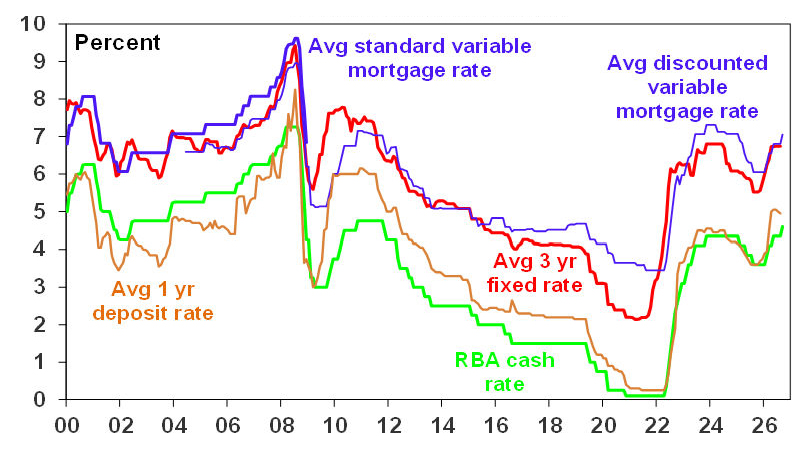
The RBA’s decision to hike by another 0.25% to 4.6% was no surprise with the money market pricing in a 93% probability of a hike and all 29 economists surveyed by Bloomberg expecting the same. The cash rate is now at its highest since October 2011. One more rate hike would take it to its highest since November 2008. Once passed on to mortgage rates, the latest hike means roughly an extra $110 a month in mortgage interest payments for mortgage holders with an average $700,000 mortgage and a total increase of $440 a month since January or $5300 year.

Australian interest rates

Source: Bloomberg, AMP


Why the RBA hiked rates again

In hiking rates again, the RBA noted the while economy has slowed, unemployment is rising and house prices have fallen, but growth is still stronger than expected, growth in business investment is strong, the labour market is still “a little bit tight” and inflation is even higher than expected with some upside risks materialising around capacity constraints, energy prices and AI related demand. It continues to see weak productivity constraining capacity and potential growth and that demand needs to stay soft for an extended period to bring inflation down to target. So with inflation too high and upside risks materialising the RBA judged a further tightening was necessary.

Not only did the RBA hike again, but it retained a tightening bias noting that it “will continue to do what it considers necessary to bring inflation sustainably back to target, including increasing the cash rate further.”

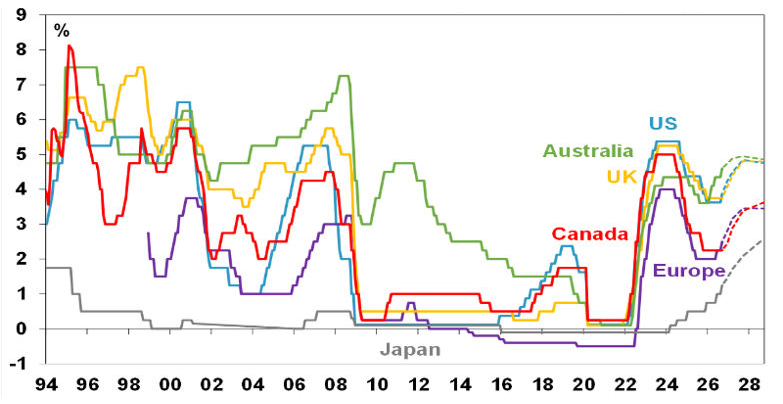
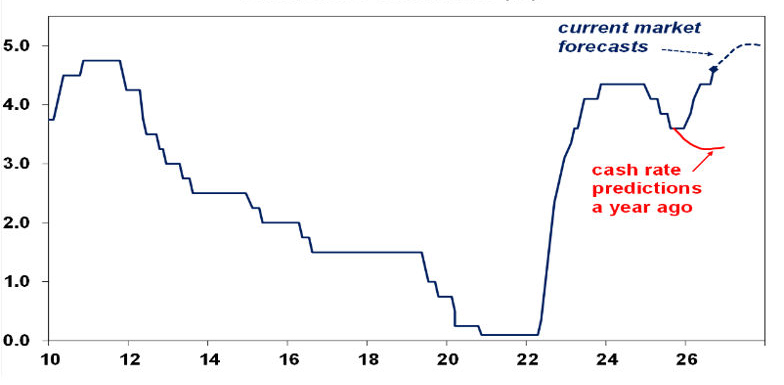
The money market is signalling another hike by February and 50% probability of yet another hike by June next year. Australian interest rates are expected to remain higher compared to other major countries reflecting inflation in other major countries being closer to. 

Official interest rates and implied market pricing

Dashed lines from now show money market expectations. Source: Bloomberg, AMP

The RBA is likely at the top, but…

Another rate hike is high risk for several reasons:

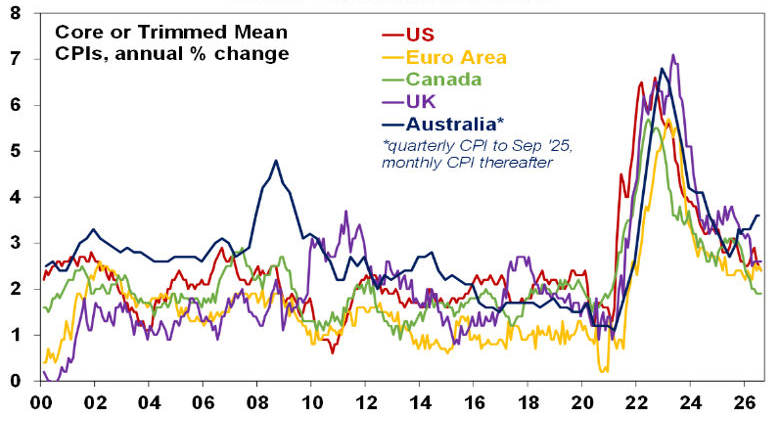
  • First, underlying or trimmed mean inflation is still too high. At 3.6%yoy its way above the 2-3% target, there is no downtrend yet and its high compared to other major developed countries. 


Global Core Inflation Rates

Source: Bloomberg, AMP

  • Second, various cost pressures point to higher inflation. The Fair Work Commission’s granting of a 4.75% increase in award wages and 6% increase in the minimum wage from July points to an acceleration in wages growth this year which is unsupported by productivity growth running at -0.2%yoy, second round impacts from the oil supply shock are still in the pipeline with oil and petrol prices on the rise again with no clear end in sight to the hit to oil supply from the Persian Gulf, the AI data centre boom is adding to construction and material costs and business surveys still point to elevated cost and output price pressures compared to the pre-pandemic years.

  • Third, the credibility of the 2-3% inflation target and the RBA’s commitment to it remain at risk. Inflation has been above target for five of the last six years including the present year, and the longer this remains the case the more people will expect this to be the new reality. If left unchecked this will show up in faster wage demands and businesses inclined to put through price rises more regularly. 

  • Fourth, it’s still not clear the economy has slowed enough to rebalance demand with supply and ease capacity constraints.

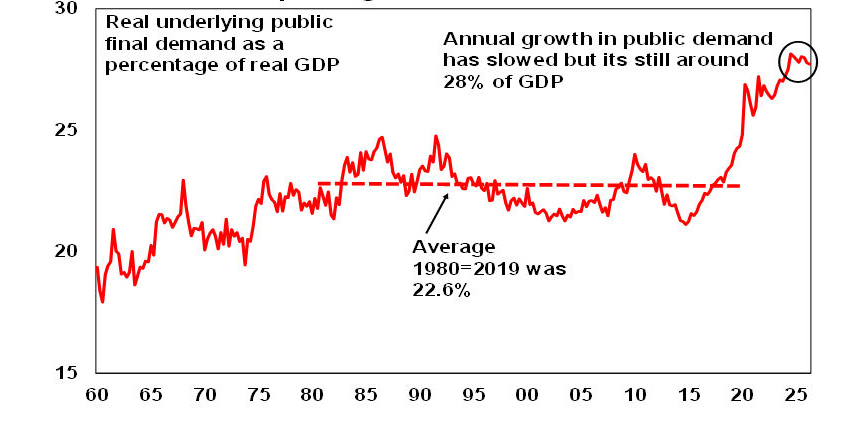
  • Finally, the level of public demand remains strong. Federal spending is projected to remain just below 27% of GDP for the next few years, which is well above pre-pandemic levels and in turn implies that total public spending overall will remain around 28% of GDP, which is well above pre-pandemic levels. Sure, the rate of growth in public final demand has slowed a bit but it’s the level of demand that counts when considering excess demand and capacity constraints in the economy as drivers of inflation.

Public spending as a share of Australian GDP

Source: ABS, AMP


So, the risk of another rate hike remains high and at the very least the RBA is likely to retain a tightening bias for some time to come. However, by the time the next RBA meeting comes around in November there is likely to be more evidence of a cooling economy, sharply falling home prices, a softer jobs market and rising recession risks so we don’t think a second hike let alone a third will be necessary. In particular:

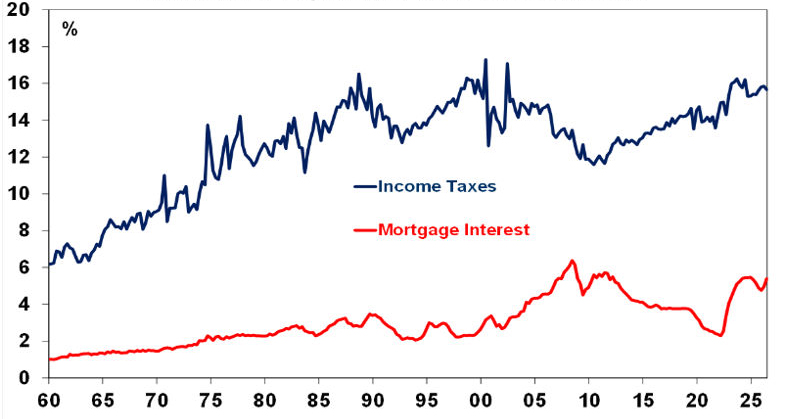
  • The share of household income devoted to mortgage interest payments is already pushing up to the highs reached in 2024, which was not far from the pre-GFC high. And this chart does not fully reflect the May rate hike let alone this week’s rate hike. 

Household Payments, % of Gross Income

Source: ABS, AMP

  • The rise in petrol prices to current levels implies roughly another $90 a month impost on a households relative to January.

  • Falling home prices imply an increasing drag on consumer spending via a negative wealth effect. Prices are expected to fall roughly 10% top to bottom. The RBA estimated a few years ago that a 10% fall in home prices will reduce consumer spending by around 0.8% after two quarters and 1.6% over the long run.

  • The latest rate hike runs the risk that we may be close to a tipping point for some mortgage holders, resulting in increased distressed selling of homes. This in turn will add to already weak home buyer demand possibly risking an even deeper fall in home prices and hence a bigger negative wealth effect. 

  • Unemployment is trending up which will add to mortgage stress cutting into consumer spending and also running the risk of increased distressed home sales further depressing home prices.

  • Although its early days, household spending was flat in August and fell 0.3% after allowing for higher fuel bills and is showing signs of softening in line with poor consumer confidence.

These considerations suggest a further slowing in demand, and an increasing risk of recession, both of which will mean ultimately slower inflation. So, while a second hike is a high risk it’s not our base case and we expect to see an extended hold out to around mid-next year at 4.6%. The RBA is likely to be in a position to start cutting rates next year, but not until the second half.

As an aside its worth noting just how much expectations for the cash rate have changed over the last year. Just as many (including me) got too optimistic on rates last year, many may now be getting too pessimistic.

Australia’s Cash Rate (%)

Source: Bloomberg, AMP

But surely there is a better fairer way to cool inflation?

Higher interest rates work to slow inflation by taking spending power away from indebted households and businesses which then reduces excess demand in the economy and eventually lowers inflation. However, this disproportionately impacts households with a mortgage and in that sense is unfair. 

The alternative would be for the government to cut its spending and/or raise taxes (or maybe even temporarily raise the superannuation contribution rate) to help lower private spending to spread the load more fairly. However, governments being run by politicians cannot be relied on to cut spending and raise taxes in times of inflation because its politically unpopular, so after chronic inflation problems in the 1970s and 1980s responsibility for its control was handed to the RBA in Australia. And this is a better outcome than the alternative of risking a return to much higher inflation which disproportionately hits lower income earners.

That said, the Federal and state governments could have taken pressure off the RBA by cutting the level of public spending allowing the RBA to run lower than otherwise interest rates and spreading the pain more fairly.


Dr Shane Oliver – Head of Investment Strategy and Chief Economist, AMP
Important note: While every care has been taken in the preparation of this document, AMP Capital Investors Limited (ABN 59 001 777 591, AFSL 232497) and AMP Capital Funds Management Limited (ABN 15 159 557 721, AFSL 426455) make no representations or warranties as to the accuracy or completeness of any statement in it including, without limitation, any forecasts. Past performance is not a reliable indicator of future performance. This document has been prepared for the purpose of providing general information, without taking account of any particular investor’s objectives, financial situation or needs. An investor should, before making any investment decisions, consider the appropriateness of the information in this document, and seek professional advice, having regard to the investor’s objectives, financial situation and needs. This document is solely for the use of the party to whom it is provided.